
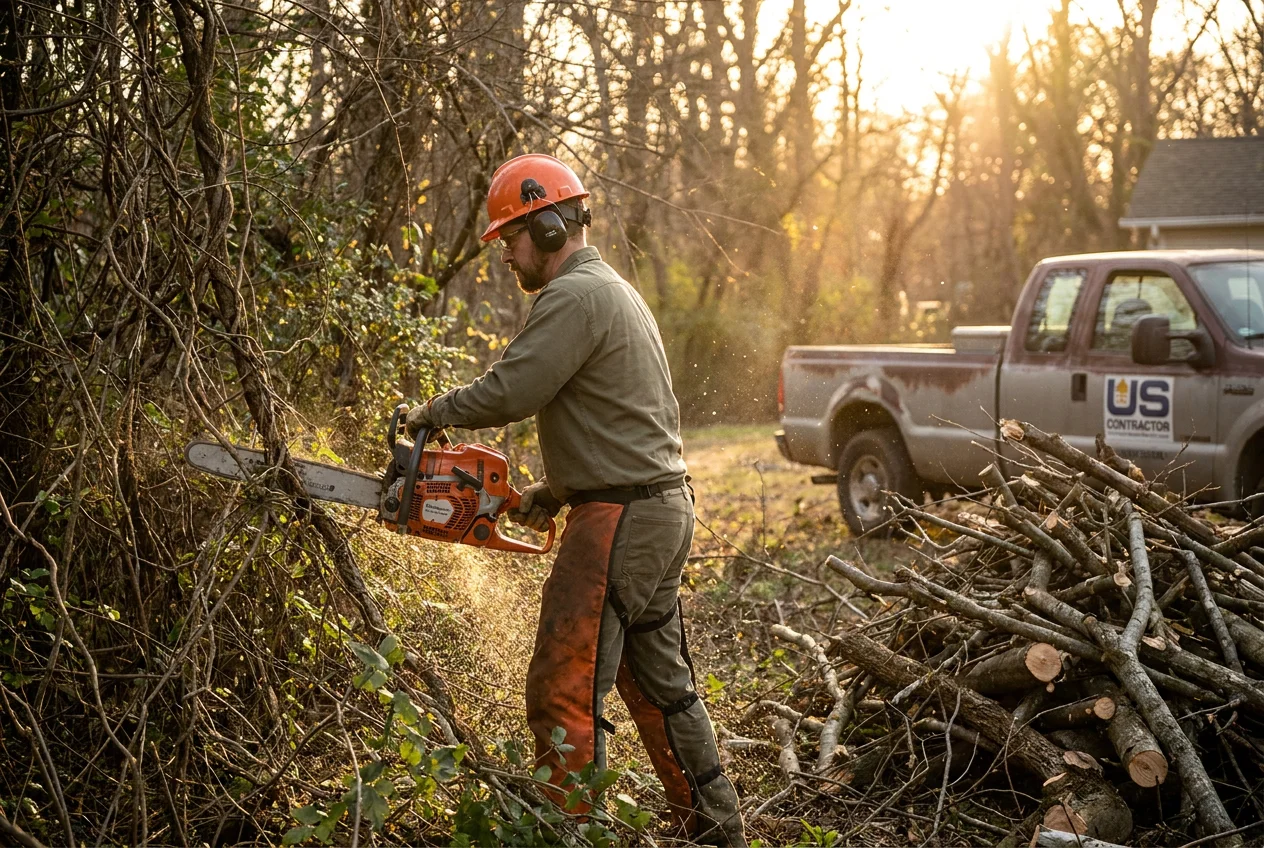
Brush clearing covers two jobs that are often confused. One is vegetation management: opening up overgrown land, reclaiming pasture, cutting fence lines, clearing a building envelope. The other is wildfire fuel reduction, which is a regulated activity in much of the western United States with defined distances, defined standards, and in many jurisdictions an inspection regime. The equipment overlaps. The objectives, and the way success is measured, do not.
Confusing them is expensive. Land cleared to look tidy may still fail a defensible space inspection, because the standard is not about appearance but about how fire moves. Conversely, a property brought into compliance with fuel-reduction rules may still be unusable for the owner’s intended purpose. Establishing which of the two jobs is being bought, before comparing prices, is the single most useful thing a property owner can do.
Defensible space is measured in zones, not acres
The framework used across California and adopted in substance by many other western states divides the area around a structure into three concentric zones. Zone 0 runs from the building out to roughly five feet and is the ember-resistant zone, the area where wind-carried embers land and ignite. The guidance here is the strictest: no combustible mulch, no stored firewood, no vegetation against siding, gravel or pavers or bare mineral soil instead. Zone 0 is where most structures are actually lost, and it is the cheapest zone to fix.
Zone 1 extends from there to thirty feet from the structure, decks and outbuildings included, or to the property line if that is closer. It is the lean, clean and green zone: dead vegetation removed, leaf and needle litter cleared from roofs and gutters, trees spaced and limbed. Zone 2 runs from thirty feet to one hundred feet and is a fuel reduction zone rather than a clearance zone, where grass is kept short, dead material is removed, and the continuity of fuel is broken up.
The hundred-foot figure is the California minimum in State Responsibility Area lands, and local authorities may require more or apply the zones differently. Some counties set Zone 1 at fifty feet. Some cities in high-hazard areas have adopted their own ordinances. Anyone buying this work should confirm the requirement with the local fire district rather than relying on a contractor’s general knowledge, because the inspection will be conducted against the local standard.
What fuel reduction is actually trying to achieve
The purpose is not to remove all vegetation. It is to break the continuity that lets fire climb and spread. Three concepts do most of the work. Horizontal continuity is fuel that lets flame travel across the ground; breaking it means spacing shrubs and mowing grass. Vertical continuity, the so-called ladder fuel, is what lets a ground fire reach into tree crowns; breaking it means removing low branches and the brush growing beneath trees. Crown separation is the spacing between tree canopies that determines whether fire moves tree to tree.
This is why a well-executed fuel reduction job can leave a property looking substantially wooded. Mature trees, properly limbed and spaced, with the understory cleared beneath them, are not the hazard. Dense brush under those trees is. A contractor who proposes to remove everything is either misunderstanding the standard or selling more work than the situation requires.
Mulching, mowing, hand crews and grazing
Forestry mulching, sometimes called mastication, uses a rotary or drum head on a skid steer or excavator to grind standing vegetation in place and leave it as a chip layer on the ground. It is fast, it requires no haul-off, and the residue suppresses regrowth and reduces erosion. Its limits are slope, which most machines cannot safely work beyond roughly thirty degrees, and the depth of the resulting chip layer, which can itself become a fuel bed if left too thick near structures.
Brush mowing with a flail or rotary deck suits grass and light brush on accessible ground and is the cheapest option per acre. Hand crews with chainsaws and clearing saws are slower and more expensive but are the only realistic method on steep terrain, in sensitive habitat, around irrigation and utilities, and wherever selective retention matters. Targeted grazing with goats has genuine application on brushy slopes and is increasingly used by public agencies, though it is seasonal, needs containment, and does not address ladder fuels in trees.
Most real properties need a combination. The economics favor mulching the open ground and putting hand crews on the slopes, the drainages and the immediate structure perimeter. A quote that proposes one method for the entire parcel is usually a quote that has not walked it.
Timing, permits and the things that stop a job
Fuel reduction work is best completed before fire season, which across most of the western United States means late winter through spring. Working in cured vegetation during summer introduces ignition risk from equipment, and many jurisdictions restrict mechanical work in fine fuels during red flag conditions or above certain temperatures. Some require a spotter, a water supply on site, and specific spark arrestor equipment.
Bird nesting is the constraint most often discovered too late. The federal Migratory Bird Treaty Act protects active nests, and clearing brush during the nesting window, broadly spring into midsummer depending on latitude, can require survey work or a delay. Riparian corridors, wetlands and mapped habitat for listed species carry their own restrictions, and clearing within them may need a permit regardless of fire objectives.
Slope and erosion are the third constraint. Removing vegetation from a steep hillside without leaving root structure or ground cover in place trades a fire problem for a landslide problem. Mulching retains the root mass and leaves residue on the surface, which is one of its genuine advantages over grubbing or blading.
Pricing across the United States runs by the acre for mechanical work and by the crew day for hand work, and the spread between the cheapest and most expensive quote on the same parcel is routinely three to one. The drivers are slope, density and stem diameter, access for equipment, disposal method, and whether the work is being done to a written standard or to a general impression. Asking each bidder to state the zone distances they are working to, the maximum stem diameter included, and what happens to the material is the fastest way to make three quotes comparable.
States in the Northeast
States in the Midwest
- Brush Clearing in Illinois
- Brush Clearing in Indiana
- Brush Clearing in Iowa
- Brush Clearing in Kansas
- Brush Clearing in Michigan
- Brush Clearing in Minnesota
- Brush Clearing in Missouri
- Brush Clearing in Nebraska
- Brush Clearing in North Dakota
- Brush Clearing in Ohio
- Brush Clearing in South Dakota
- Brush Clearing in Wisconsin
States in the South
- Brush Clearing in Alabama
- Brush Clearing in Arkansas
- Brush Clearing in Delaware
- Brush Clearing in Florida
- Brush Clearing in Georgia
- Brush Clearing in Kentucky
- Brush Clearing in Louisiana
- Brush Clearing in Maryland
- Brush Clearing in Mississippi
- Brush Clearing in North Carolina
- Brush Clearing in Oklahoma
- Brush Clearing in South Carolina
- Brush Clearing in Tennessee
- Brush Clearing in Texas
- Brush Clearing in Virginia
- Brush Clearing in Washington, D.C.
- Brush Clearing in West Virginia
States in the West
- Brush Clearing in Alaska
- Brush Clearing in Arizona
- Brush Clearing in California
- Brush Clearing in Colorado
- Brush Clearing in Hawaii
- Brush Clearing in Idaho
- Brush Clearing in Montana
- Brush Clearing in Nevada
- Brush Clearing in New Mexico
- Brush Clearing in Oregon
- Brush Clearing in Utah
- Brush Clearing in Washington
- Brush Clearing in Wyoming
Major cities across the United States
- Brush Clearing in New York City, NY
- Brush Clearing in Long Island, NY
- Brush Clearing in Los Angeles, CA
- Brush Clearing in Chicago, IL
- Brush Clearing in Chicago, WI
- Brush Clearing in Brooklyn, NY
- Brush Clearing in Queens, NY
- Brush Clearing in Houston, TX
- Brush Clearing in Manhattan, NY
- Brush Clearing in Phoenix, AZ
- Brush Clearing in Philadelphia, PA
- Brush Clearing in Eden, CA
- Brush Clearing in San Antonio, TX
- Brush Clearing in The Bronx, NY
- Brush Clearing in Deer Valley, AZ
- Brush Clearing in San Diego, CA
- Brush Clearing in Dallas, TX
- Brush Clearing in Garfield, UT
- Brush Clearing in San Jose, CA
- Brush Clearing in O‘ahu, HI
- Brush Clearing in Austin, TX
- Brush Clearing in Jacksonville, FL
- Brush Clearing in San Francisco, CA
- Brush Clearing in Columbus, OH
- Brush Clearing in Indianapolis, IN
- Brush Clearing in Fort Worth, TX
- Brush Clearing in Charlotte, NC
- Brush Clearing in North Charlotte, NC
- Brush Clearing in Louisville, KY
- Brush Clearing in Lakeside, GA
- Brush Clearing in Seattle, WA
- Brush Clearing in Denver, CO
- Brush Clearing in Washington City, DC
- Brush Clearing in El Paso, TX
- Brush Clearing in Boston, MA
- Brush Clearing in Nashville, TN
- Brush Clearing in Detroit, MI
- Brush Clearing in Una, TN
- Brush Clearing in Memphis, TN
- Brush Clearing in New South Memphis, TN
- Brush Clearing in Portland, OR
- Brush Clearing in Oklahoma City, OK
- Brush Clearing in Las Vegas, NV
- Brush Clearing in Baltimore, MD
- Brush Clearing in Washington, D.C., DC
- Brush Clearing in Milwaukee, WI
- Brush Clearing in South Boston, MA
- Brush Clearing in Fernwood, PA
- Brush Clearing in Albuquerque, NM
- Brush Clearing in Williamson, TX
Brush clearing in the United States, USA
usually call after the property has crossed the line between manageable and a real liability, vines on the fence, saplings filling the side yard, an easement gone feral, a back corner the mower will not reach anymore. Brush clearing is the removal of that unwanted woody vegetation.

What it is not: it is not full land clearing for a foundation pad. It is not tree removal. Brush clearing sits in the practical middle, cutting back, removing, and hauling off the woody undergrowth that has gotten out of hand. The right method depends on what is growing, where, and how much.
Free brush clearing quote in the United States, USA by phone
Call (855) 321-3414How the work runs in the United States, USA

- Phone quote.Property size, brush density, access, goal. Most jobs are quoted firm on the call, no site visit needed.
- Cut, chip, drag.Two-person crew with chainsaws and chipper for residential fence lines, side yards and drainage easements. Crews typically handle a job in half a day.
- Brush hog or mulcher.Compact tractor with brush hog for tall weeds and light saplings. Tracked forestry mulcher for thick brush and acreage. Picks the tool to match the job.
- Cleanup and walk-through.Chips left as mulch or hauled off. Property walked with the owner. Before-and-after photos delivered with the invoice.
Talk to a brush clearing crew in the United States, USA
One call. A written quote. Licensed local crews near you.
Call (855) 321-3414Frequently asked questions

How much does brush clearing cost in the United States, USA?
Residential fence line or side yard typically runs $200 to $800 for a half-day crew with chainsaws and chipper. Brush hog mowing of a half-acre lot lands around $300 to $600. Forestry mulching of acreage runs $1,500 to $3,500 per acre. The phone quote is firm before a crew is dispatched.
What happens to the cut brush?
For residential jobs the brush is chipped on site (chips left as mulch or hauled off) or stacked at the curb for pickup. For forestry mulching jobs the material is left in place as organic mulch, no haul-off, no burn pile, no dumpster.
Do you serve United States?
Yes, crews are dispatched . One call confirms availability and a written estimate before any work.
Do you handle the stumps?
Brush clearing covers everything up to 6 inch diameter as standard. Larger stumps are quoted separately as stump grinding or pulled with a mini-excavator if a true clear is needed. For most fence lines and easements stumps are cut flush and left to decompose.
How fast can a crew be on site?
Residential brush clearing is typically scheduled within the same week. Fire-defensible-space jobs are prioritized during burn-ban season. right-of-way work can usually start within 48 hours of a signed estimate.
Are the crews insured?
Every crew dispatched is . Certificate available on request before any work begins.